
Finding her
The most detailed account of how the SS Persia wreck was found is Stephanie Pain’s report in New Scientist, published on 13 December 2006. Deep Tek, a Scottish firm run by Alec and Moya Crawford, went looking in 2001. There were three different reports of the ship’s last position, so the wreck could have been anywhere in almost 800 square kilometres of sea, at depths between 2,500 and 4,500 metres. They started from the position in Valentiner’s own log. A magnetometer spike, then a sonar outline on the last day of the season, gave them a ship. Cameras confirmed it the following March: the funnels torn away, two holes where they had stood, and the Persia sitting upright at 2,800 metres. Documented in that account.
Why anyone went
Money. New Scientist reports that the manifest and insurers listed bullion worth some £30 million. Alongside it ran a story of gold and jewels belonging to Maharaja Jagatjit Singh of Kapurthala. A 2023 paper for the International Gemmological Conference notes that the Maharaja and most of his party never joined the ship at Marseille, though members of his staff did. The treasure story is Legend until something proves it.
Five decks down
The target was the bullion room, a small vault between the mail and baggage rooms, five decks below. The steel at that depth was barely corroded, so Alec Crawford designed a crushing grab with a closing force of 1,100 tonnes to pop the rivets. The last barrier was the six-centimetre concrete floor of the first-class pantry. By 2004 the team had cut through all five decks and removed 100 cubic metres of material from the bullion, baggage and mail rooms. New Scientist calls it the world’s deepest commercial salvage operation inside a wreck.
What came up
No gold. “The bullion room was full of material,” Moya Crawford told New Scientist, “but nothing shiny.” What did come up was the ship’s ordinary life: monogrammed plates and cutlery, bottles, bundled newspapers, and Christmas mail bound for India, including silk socks, a home-made tie, diaries for 1916 and a pair of baby’s bootees. Then the gems. The IGC paper counts over 300 natural and synthetic rubies, 44 moonstones, five amethysts and one garnet. New Scientist reports that about two-thirds were synthetic, among the earliest datable synthetic rubies known. The IGC authors say plainly that nobody knows whose they were.
Where it went
The finds went home to the Montagu estate. The IGC paper says Deep Tek wanted a home for them, and the Montagu link made Buckler’s Hard Maritime Museum, on the Beaulieu estate, the logical place. A permanent SS Persia exhibition opened there in 2008. The Southampton Daily Echo, in an undated report on the opening, describes the bullion-room door as a centrepiece and records that Eleanor’s grandson, Richard Moorby, attended and called her “most ambitious.” Buckler’s Hard says the Montagu family commissioned a memorial sundial for the centenary of the sinking. Gems gifted by Deep Tek were set into a limited jewellery range by Alex Goodman of Goodman Morris, with proceeds going to Smile Train and the Mission to Seafarers.
What it means for Eleanor
Nothing in any source we have read identifies a recovered object as Eleanor’s, or as Montagu’s, and this site will not suggest one. Her body was never found, as our no grave note sets out, and the tablet Montagu raised is covered in the memorial note. The wreck is the one fixed place the record gives her. For the sinking itself, read the Persia note and eleven days before the Persia.
What stays open
The sources disagree, and this site does not smooth them over. On the numbers aboard: 519 with 343 lost (house record and Wikipedia), 501 with 167 saved (New Scientist), and 500 to 507 (the IGC paper). On depth: 2,800 metres (New Scientist, IGC), about 3,000 metres (Wikipedia), 8,400 feet (Daily Echo). On dates: the search began in 2001, but Wikipedia gives 2003 for the discovery, and the exact year of camera confirmation is not stated as a number. The gem count also varies between reports. All four stay OPEN.
Why it matters for the novel
Margot Dorée wrote The Woman on the Bonnet under the house rule: documents first, gaps labelled, no invented scenes passed off as record. North Star Publishing Group published it. The salvage came long after the years the novel covers; this note records it as history, not as part of the book. For the wider story, start with who Eleanor Thornton was or the Montagu note.
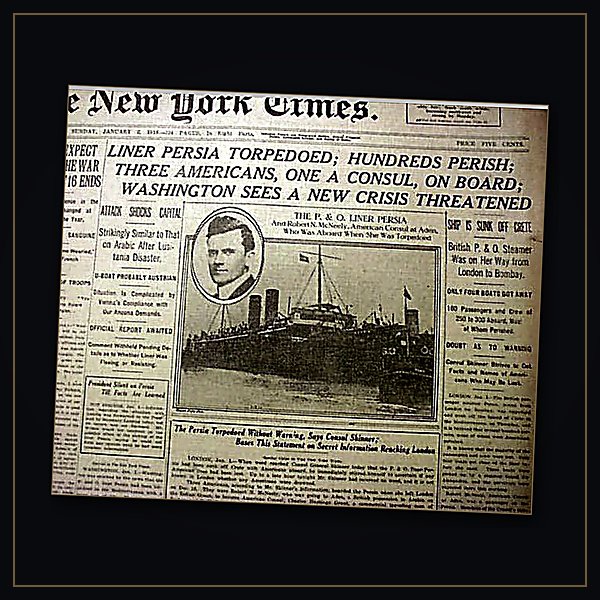
Sources: Stephanie Pain, “Deep secrets of the SS Persia,” New Scientist, 13 December 2006 (search from 2001, three positions, Valentiner log, 2,800 m upright, £30 million manifest figure, five decks, 1,100-tonne grab, concrete pantry floor, 100 cubic metres, “nothing shiny” as printed, mail finds, two-thirds synthetic, 501 / 167). Stephen Kennedy, Mary Montagu-Scott and Susan Tomkins, “Snapshot of rubies from 1915,” International Gemmological Conference 2023 (located 2001 at 2,800 m, gem counts, Maharaja did not board, ownership unknown, Buckler’s Hard exhibition 2008, 500 to 507 aboard). Buckler’s Hard, “SS Persia” exhibition page (2003 salvage, centenary sundial, Deep Tek gift, Goodman Morris jewellery, charities). Keith Hamilton, “Lasting memorial to SS Persia’s tragic end,” Daily Echo (publication date not confirmed; bullion-room door, Richard Moorby quote as printed, 8,400 feet). Wikipedia, “SS Persia (1900)” (519 / 343, discovery 2003, about 3,000 m). Persia date 30 December 1915 per house record. Period newspaper image: The New York Times, 2 January 1916, public domain in the United States. Novel independent, not affiliated with Rolls-Royce Motor Cars Limited.