
A shipwreck novel based on a true story is allowed a document. It is not allowed a last speech. Eleven days before the P&O liner Persia went down, Eleanor Velasco Thornton wrote to his wife. That letter is in the publisher A+ record for The Woman on the Bonnet. It is in her own handwriting. This page will not invent a cabin in which she wrote it, and it will not put words in her mouth at 1.05 on 30 December 1915.
The A+ copy names the addressee as his wife. In that record, “his” refers to Lord Montagu of Beaulieu, the man she had served and loved in secret, the man who was also aboard. The letter is labelled as the A+ record.
She made the arrangement privately, so that he could never overrule it. The sentences the record keeps are these:
“I think it will be best for me to make arrangements without telling Lord Montagu, so he cannot raise objections. The lord will have an extra chance, for there will be my place in the boat for him, even if he has to be stunned to take it.”
That is the document. A shipwreck novel based on a true story can use it because it is hers. It cannot turn it into a speech on the boat deck. The newspapers did not print a last speech. The WW1 note already said so. This page says it again, because the letter is the thing people want to decorate.
He lived. The A+ record has him thirty hours in the water, held up against his own will by an inflatable waistcoat he had bought over a shop counter days before. On a sickbed in Malta he said the only thing left to say: “I should have got a stronger grip on her.” Those sentences stay labelled as the A+ record. They are not a scene written for the end of a chapter.
Then he went home and raised a memorial to her in his wife’s own parish church, where it still stands. It records that she served him devotedly for fifteen years. On permanent public display, and completely unreadable. That is also A+ copy. This site does not claim the church. It does not claim a museum partnership. It does not use a modern photograph of the memorial.
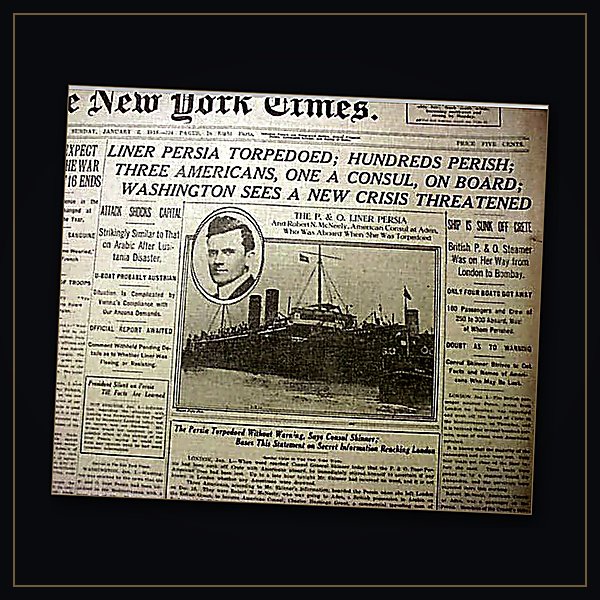
The liner is not a legend. The New York Times of 2 January 1916 put the sinking on the front page. Three days earlier, on 30 December 1915, luncheon was being served aboard the Persia off the coast of Crete when a torpedo struck without warning. Colonel the Hon. C. Bigham telegraphed Lord Inchcape of P&O from Alexandria: hit on the port bow at 1.05 in the afternoon, about forty miles south of the east end of Crete, no warning, gone within five minutes. Four of the boats that got away were thirty hours at sea.
The numbers moved. Bigham’s first count was 158 persons landed out of 350. The figure used in the publisher record is the one that settled later: five hundred and nineteen people aboard, three hundred and forty-three lost. Only fifteen women lived. Where two counts fight, the novel does not pick a prettier one. Eleanor was among the dead. She is the woman behind the flying lady, the face Charles Sykes would not name. A shipwreck novel based on a true story can put her on the Persia because the Persia took her.
The older Persia note holds this same front page in a shorter form. The notes index holds the rest. This page owns the eleven days and the letter as the A+ record has them.
Margot Dorée wrote The Woman on the Bonnet in that lane. North Star Publishing Group published it. The artefacts are labelled. The flying lady is a trademark of its owner. Nothing here is a claim that Rolls-Royce asked for the book. Nothing here is a partnership with a museum. The woman who sat for the face was real. The liner that took her has a date. The letter has a place in the record, and it is not a last speech.
If you want a shipwreck novel based on a true story that will use the letter and will not invent the four minutes, the book is the place the record goes next.
Sources: Publisher A+ record for The Woman on the Bonnet (eleven days before she drowned she wrote to his wife; Eleanor’s own handwriting; the quoted arrangement about her place in the boat; thirty hours; inflatable waistcoat; Malta line; memorial in his wife’s parish church). The A+ addressee is his wife (Lord Montagu). The New York Times, 2 January 1916 (front page, public domain in the United States). Colonel C. Bigham’s telegram to Lord Inchcape, as used on the WW1 note (1.05 p.m., 30 December 1915, about forty miles south of the east end of Crete; 158 landed of 350 in that first count). Passenger figures 519 / 343 / fifteen women as used in the A+ record. No last speech. No invented scenes.