
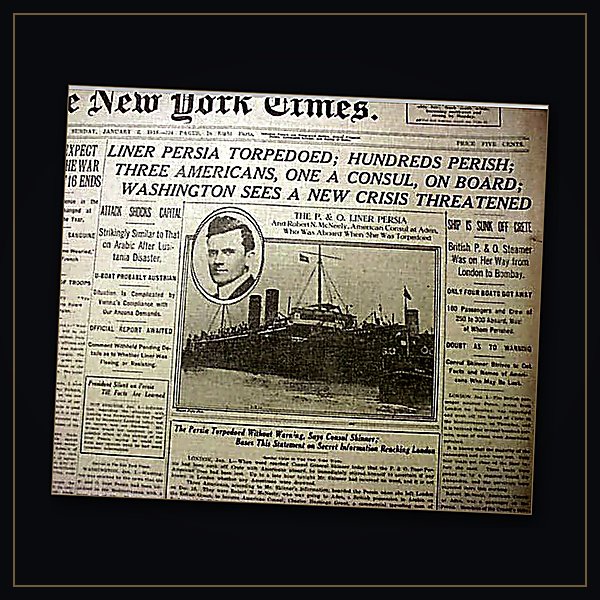
WW1 historical fiction based on a true story has a hard job. The war is already full of invented rooms. The record of the P&O liner Persia is not one of them.
The New York Times of 2 January 1916 put the sinking on the front page. Three days earlier, on 30 December 1915, luncheon was being served aboard the Persia off the coast of Crete when a torpedo struck without warning. That is the public fact. A passenger, Colonel the Hon. C. Bigham, telegraphed Lord Inchcape of P&O from Alexandria: the ship was hit on the port bow at 1.05 in the afternoon, about forty miles south of the east end of Crete. No previous warning was given. There was no attempt at assistance. Within five minutes the ship had gone. The list to port made the starboard boats impossible to lower. Four of the boats that got away were thirty hours at sea before a British ship found them.
That telegram is the spine. It is not a scene. It is a timed report from a man who was washed overboard when a boat capsized. He wrote that the conduct of the passengers and crew was splendid, that there was no struggling and no panic. WW1 historical fiction that wants to be believed should leave those sentences alone.
The numbers moved, as they always do after a liner goes down. Bigham’s first count from Alexandria was 158 persons landed out of 350. The New York Times of 4 January 1916 still had the death list exceeding two hundred, and named the American consul at Aden, Robert N. McNeely, as lost. The figure used in the publisher record for The Woman on the Bonnet is the one that settled in later tallies: five hundred and nineteen people aboard, three hundred and forty-three lost. Only fifteen women lived. Where two counts fight, the novel does not pick a prettier one.
Eleanor Velasco Thornton was among the dead. She was forty. She is the woman behind the flying lady, the face Charles Sykes would not name, the secretary at the table who was not a secretary. Eleven days before she drowned she wrote to his wife. That letter is in the record the novel used. A shipwreck novel based on a true story can put her on the Persia because the Persia took her. It cannot give her a last speech the newspapers did not print.
The Persia herself is not a legend. She was a P&O passenger liner, built in 1900 by Caird & Company at Greenock. She was a British ship, presenting herself openly, on a wartime run. The German submarine later identified in the naval record as U-38, commanded by Max Valentiner, fired without stopping her. Cruiser rules said a merchant ship could be searched for contraband and sunk only if the people aboard were put in a place of safety. Lifeboats on the open winter sea were not that place. The American papers treated the sinking as an outrage because an American consul died in it, and because the shot came with no warning. That is the WW1 the novel is standing in: not a battlefield invented for atmosphere, but a passenger list and a front page.
This is why the keyword is not decoration. People search for WW1 historical fiction based on a true story when they are tired of a war that never happened. They search for a shipwreck novel based on a true story when they want the water to be real. Eleanor Thornton, Edwardian England forbidden love, the Spirit of Ecstasy, Lord Montagu of Beaulieu, Charles Sykes and The Whisper: those are the other doors into the same house. The sea is the one that closes.
Margot Dorée wrote The Woman on the Bonnet in that lane. North Star Publishing Group published it. The artefacts on this site are labelled. The New York Times page is a period newspaper. The photograph of Eleanor is a period photograph. The drawing-room picture is an illustration, and it says so. Nothing here is a museum partnership. Nothing here is a claim that Rolls-Royce asked for the book. The flying lady is a trademark of its owner. The woman who sat for the face was real, and the liner that took her has a date.
If you want WW1 historical fiction that will not invent the four minutes, the book is the place the record goes next.
Sources: The New York Times, 2 January 1916 (front page, public domain in the United States) and 4 January 1916 (death list still in motion; Robert N. McNeely named). Colonel C. Bigham’s telegram to Lord Inchcape, printed in contemporary P&O reporting (hit at 1.05 p.m., 30 December 1915, about forty miles south of the east end of Crete; no warning; sunk within five minutes; 158 landed at Alexandria in that first count). Passenger figures 519 / 343 as used in the novel’s publisher A+ record. Ship: P&O Persia, built 1900, Caird & Company, Greenock. U-38 / Max Valentiner as later naval identification, not as an eyewitness name on the day. Eleanor Thornton’s death with the Persia as used in the A+ record and on this site. No invented scenes.