Who he was (Documented)
The plain line on Charles Sykes and Eleanor Thornton starts with the sculptor’s own dates. Charles Robinson Sykes was born on 18 December 1875 in Brotton, a mining village near Cleveland in the north-east of England, and died on 6 June 1950. Those dates come from Rolls-Royce Motor Cars’ own “Makers of the Marque” note on him, published 16 December 2024. He trained at Rutherford Art College in Newcastle, won a scholarship to the Royal College of Art in London in 1898, and worked as illustrator, painter and sculptor. His magazine covers and commercial drawings survive in public collections that include the Victoria and Albert Museum and the British Museum. Documented in that corporate heritage note.
How Eleanor entered the work (Corroborated)
Around 1902 a magazine publisher who could not pay in cash introduced Sykes to John Scott-Montagu, then building the weekly The Car Illustrated. Sykes supplied the illustrated side of the title. Eleanor Velasco Thornton was Montagu’s assistant on that magazine, and Rolls-Royce’s heritage note calls her Sykes’s long-time favourite muse, posing for him on many occasions. The National Motor Museum’s Leamington blue-plaque note (9 June 2026) says she had already modelled for him before the magazine years, and that their professional link deepened through the shared work. We keep both and do not invent a first sitting. For the magazine itself, see the Car Illustrated note.
The Whisper (Corroborated, date OPEN)
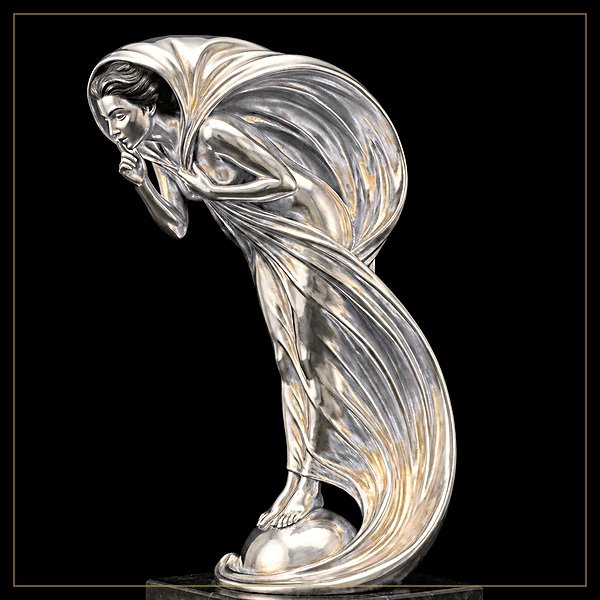
Before Rolls-Royce had an official emblem, Lord Montagu had a private one. Sykes made him a hush figure: a small silver woman leaning into the wind with a finger on her lips. Hush. Say nothing. House record and the short Whisper note treat that commission as earlier than the public Spirit of Ecstasy. Rolls-Royce’s Spirit of Ecstasy press kit says the precise date of The Whisper remains a mystery, and that the original piece is on permanent display at the National Motor Museum, Beaulieu. The museum’s own June 2026 blue-plaque page dates Montagu’s personal Whisper commission to 1913, after the 1911 public figure. That order clashes with the house and Rolls-Royce sequence. OPEN: the calendar year of The Whisper. This site does not smooth the disagreement away.
The public figure (Documented)
Claude Johnson, Rolls-Royce’s first Commercial Managing Director, asked Sykes for an official mascot so owners would stop bolting cartoon animals to the radiator. Rolls-Royce registered the Spirit of Ecstasy on 6 February 1911. Sykes supervised production from his studio over a furrier’s shop at 193 Brompton Road from 1911 to 1928; his daughter Jo later took charge until 1948. Eleanor is widely held to be the model. Sykes was asked whose face it was for the rest of his life and never once answered, so this site keeps the widely held view and does not invent a confession. See the Spirit of Ecstasy Rolls-Royce note and the woman behind the flying lady.
What this page will not do
No invented studio dialogue. No claim that Rolls-Royce asked for the novel. No faithful trademarked mascot product shot. The image on this page is an illustration of The Whisper pose used on this site, labelled as such. For Montagu and Eleanor as names together, read the Lord Montagu note. For who she was in one short answer, start with who was Eleanor Thornton.
Why it matters for the novel
Margot Dorée wrote The Woman on the Bonnet under the house rule: documents first, gaps labelled, no invented scenes passed off as record. North Star Publishing Group published it. Sykes is the sculptor the public figure cannot be told without. Eleanor is the working secretary whose face the sculptor would not name. The book lives in that silence without filling it with a speech he never gave.
Sources: Rolls-Royce Motor Cars, “Makers of the Marque: Charles Robinson Sykes,” 16 December 2024 (birth 18 Dec 1875 Brotton; death 6 Jun 1950; RCA 1898; Car Illustrated introduction c.1902; Eleanor as muse; Whisper date mystery; Spirit of Ecstasy via Claude Johnson; 193 Brompton Road production 1911–1928; Jo Sykes to 1948; V&A and British Museum holdings). Rolls-Royce Motor Cars, Spirit of Ecstasy press kit (Whisper for Montagu’s Silver Ghost; original at National Motor Museum, Beaulieu; Johnson official-mascot commission). National Motor Museum, “Eleanor Thornton commemorated with Blue Plaque,” 9 June 2026 (Sykes on Car Illustrated; Whisper dated 1913 on that page; likeness extent open). Publisher A+ record for The Woman on the Bonnet (Whisper before the public figure; Sykes never named the face; registration 6 February 1911 as used on sibling notes). Novel independent, not affiliated with Rolls-Royce Motor Cars Limited.