The magazine
The Car Illustrated. A Journal of Travel by Land, Sea, and Air was a British weekly. Its first issue is dated 28 May 1902. Its editor was the Hon. John Scott-Montagu, then a Member of Parliament and already a motoring man: in 1899 he drove a 12 hp Daimler into the yard of the House of Commons, and the same year his Daimler took third in the touring class of the Paris–Ostend race. Beaulieu’s own account says he launched the paper with encouragement from Alfred Harmsworth, later Lord Northcliffe. The subtitle tells you how wide he meant it to range. Cars came first, but the sea and the air were in the masthead from the start.
Her place in it
Beaulieu’s 2016 article on Eleanor says that when Montagu launched the magazine in 1902 he invited her to join him as his personal assistant. Her duties grew after November 1905, when his father died and he became the second Baron Montagu of Beaulieu and moved from the Commons to the Lords. The same article cites his personal diaries: she proved indispensable across his work as politician, landowner, editor, publisher and political writer. That is the documented shape of the job. It ran through one office and one man’s many roles, and the magazine sat in the middle of it.
No byline of hers is known to this site. It is tempting to imagine her hand in the copy. We have not seen a page that proves it, so this note does not claim it.
Where the sources differ
The order of her early jobs is not settled. Beaulieu says that on leaving school at sixteen she was hired as a secretary at the Royal Automobile Club in London, where she met Montagu, and that the magazine post came in 1902. The Leamington History Group, in its June 2026 plaque note, writes that the names Eleanor and Velasco appear to have been taken up when she started work in the office of The Car Illustrated after leaving school at sixteen, and also places her first secretarial post with the club. She was born in April 1880, so sixteen is 1896, six years before the first issue. Both accounts agree on the club, the magazine and the man. They do not agree on the sequence, and this site leaves it open. The blue plaque note and the Stockwell note give the family side.
Sykes and the motoring circle
Beaulieu names the sculptor Charles Robinson Sykes among Montagu’s connections and says Eleanor became one of his favourite models. Montagu introduced Sykes to Claude Johnson of Rolls-Royce, and the commission for the Spirit of Ecstasy followed. Our research file also points to Sykes artwork inside the magazine itself. We have not yet seen those covers, so that stays a lead to check in the run, not a fact. The Whisper note covers the earlier figure, and the Montagu note covers the man.
Where the run is kept
The National Motor Museum Trust at Beaulieu says its Reference Library was opened by Edward, Lord Montagu, on 28 April 1961 in the old kitchens of Palace House, built on his father’s collection of motoring books and journals. It moved to the John Montagu Building in 1973 and to the Trust’s Collections Centre on 6 November 1989. The Trust lists Car Illustrated among its periodical titles. Access is through its Motoring Research Service. So the weekly that filled her working years now sits on shelves her lover’s son opened to the public.
What the magazine does not tell us
A trade weekly records cars, races and roads. It does not record a private life, and nothing in the published record shows the affair in its pages. What it gives a reader is the world she worked in, week by week, through the years she worked beside it. The fact sheet keeps the ten points we can source, and the Persia note covers how those years ended.
Why it matters for the novel
Margot Dorée wrote The Woman on the Bonnet inside the same rule: the documents first, the gaps labelled, and no invented scenes passed off as record. North Star Publishing Group published it. The office of The Car Illustrated is where the record places Eleanor for most of her adult life. The novel works from that fact and keeps the open questions open.
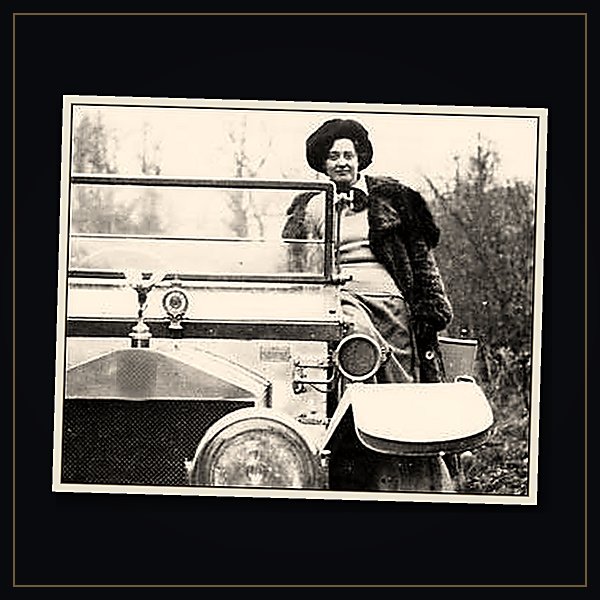
Sources: Beaulieu, “Women in Motorsport & Social History: Eleanor Thornton” (Sarah Crofts, 3 June 2016) at beaulieu.co.uk: 1902 launch with Harmsworth’s encouragement; personal assistant; 1905 succession; diaries “indispensable”; RAC secretary at sixteen; Sykes and Claude Johnson. Wikipedia, “The Car Illustrated” (citing Oxfam GB, Volume 1 Number 1, and National Motor Museum Trust, “The Motoring Montagus”): first issue 28 May 1902; weekly; full title; editor; 1899 Commons yard and Paris–Ostend. National Motor Museum Trust, “Library Collection”: library dates and Car Illustrated holdings. Leamington History Group, “Nelly Thornton, Blue Plaque” (June 2026): names and office at sixteen; RAC. Sykes magazine artwork: house research lead, not verified. Period photograph of Eleanor Thornton, public domain in the United States. Novel independent, not affiliated with Rolls-Royce Motor Cars Limited.