
The woman behind the flying lady is a search phrase. It is not a name. People type it because they have seen the silver figure and have never been given Eleanor Velasco Thornton.
That is the claim of this note, and it is a small one. The public name of the figure is the Spirit of Ecstasy. The flying lady is how a reader asks for the face without already knowing the woman. Both phrases meet in the same house. Neither is a museum partnership. Neither is a claim that Rolls-Royce asked for a book.
Charles Sykes made the figure. He was asked whose face it was for the rest of his life and never once answered. The publisher A+ record for The Woman on the Bonnet keeps that refusal. It does not invent a studio speech to fill the gap. Historical fiction based on a true story that wants to be believed should leave a silence that held.
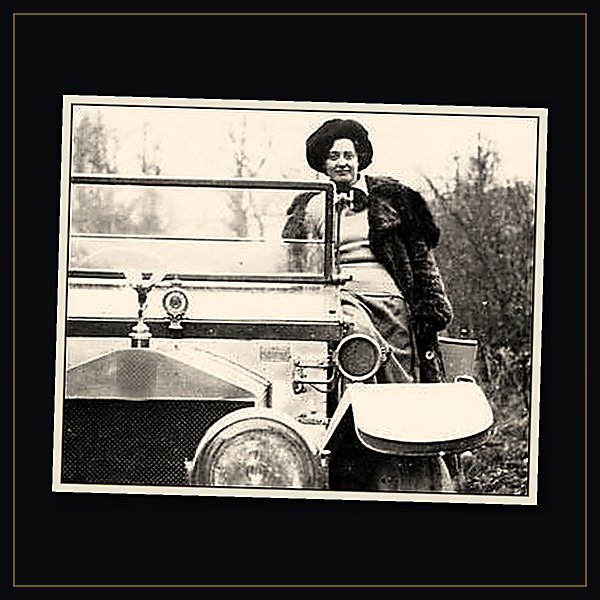
She was introduced, on the day the photograph on this page was taken, as a secretary. The A+ record uses that word. A secretary is a woman at the table who is not the reason the table was set. The woman behind the flying lady was the reason. The record and the introduction do not agree. The page does not tidy them.
The photograph is a period photograph. It is labelled period. It is one of the very few of Eleanor Thornton that survive. She stands in a fur coat beside a vintage motor car. At her shoulder the little silver woman is already cast and already being sold. The radiator badge has been retouched out. The image is public domain in the United States. It is not a trademarked mascot product shot. It is not a modern photograph from Beaulieu or from the National Motor Museum. It is not an Alamy plate.
The date on which Rolls-Royce registered the figure is already set down on the Eleanor Thornton note on this site: the sixth of February, 1911. If you came here on the phrase the woman behind the flying lady, you already had the figure and not the woman. The other note holds the registration. This one holds the search.
What else is safe to say from the same record, and no further? She was a telegraph engineer’s daughter from Stockwell who had built herself, name and all, out of nothing. That sentence is in the A+ copy and on the fifteen-years note. She was loved in secret for fifteen years by a man who was not free to love her. There was a daughter she was never allowed to keep. Those are not rooms. They are facts the house has already labelled. They have their own pages.
Before the public figure there was a hush figure. Lord Montagu of Beaulieu commissioned The Whisper from Charles Sykes, and Eleanor sat for it. That commission has its own note. The Whisper is not the Spirit of Ecstasy. The flying lady, as a search, points at the public face.
The sea is another door and not this one. Eleanor Velasco Thornton drowned with the P&O liner Persia on 30 December 1915. A shipwreck novel based on a true story can put her on that passenger list because the Persia took her. The WW1 note holds the telegram and the counts that fight. This page will not retell the four minutes, and it will not invent a last speech the newspapers did not print.
She is the most looked-at woman in the world. Nobody ever told you she was real. That pair of sentences is in the A+ record. It is not a scene. It is why the search phrase exists. The woman behind the flying lady has a name. The sculptor would not give it. The period photograph will.
Margot Dorée wrote The Woman on the Bonnet in that lane. North Star Publishing Group published it. The artefacts on this site are labelled. The notes index is the door to the rest of the record. The flying lady, as a mark, is a trademark of its owner. The woman who sat for the face was real. Nothing here is a claim that the company asked for the novel. Nothing here is a partnership with a museum.
If you searched for the woman behind the flying lady, you were looking for a name. The name is Eleanor Velasco Thornton. The book is the place the record goes next.
Sources: Period photograph of Eleanor Thornton, published before 1930 and therefore public domain in the United States. The radiator badge has been retouched out. Charles Sykes’s refusal to name the face, the secretary introduction, Stockwell, the fifteen years, and the most looked-at woman as used in the novel’s publisher A+ record. Registration date of the figure: the Eleanor Thornton note on this site (sixth of February, 1911). No trademarked mascot product shot. No Beaulieu or National Motor Museum modern photographs. No Alamy. No invented scenes.