


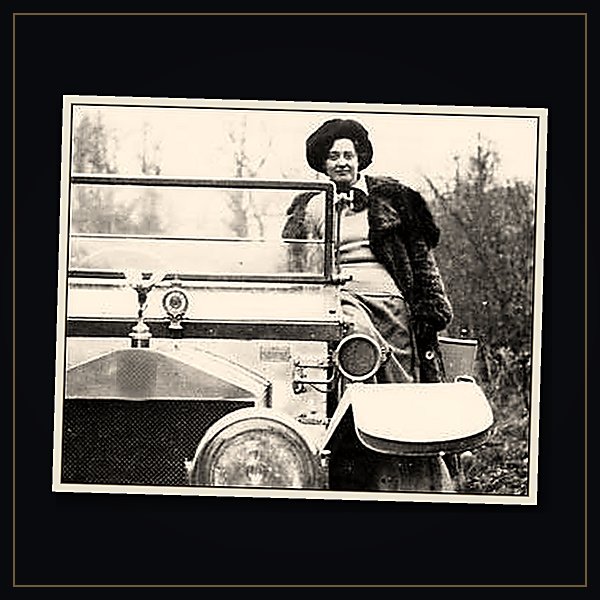
What the plaque marks
The Leamington History Group published its note on the Eleanor Thornton blue plaque on 9 June 2026, with photographs of the unveiling in Charlotte Street on 4 June. The group calls her by the name she was born with, Nelly Thornton, and gives her dates as 1880 to 1915. That matters to anyone who has only met her as Eleanor Velasco Thornton. The plaque honours a girl from an ordinary working family before it honours the face on a radiator.
Why Leamington
The group’s answer is her father. Frederick Thornton, an Australian-born telegraph engineer, came to Leamington as chief engineer for Messrs Chamberlain & Hookham of Birmingham, the firm that electrified the town centre in 1887. The company bought six houses at the end of Wise Street, pulled them down for a sub-station, and had him oversee the whole installation, trenches and cabling included. The Town Hall and the Pump Rooms came first, then shops on the Parade and Bath Street. The local Courier of 22 October 1887 told readers the engineer was Mr Fred Thornton, who had carried out the task “with skill, ability and judgement.” By September 1887, when her sister Rose was born, the family were living in the town. When the contract ended they moved on again.
So the plaque is honest about scale. Leamington was a chapter of her childhood, not her whole life. Her birth is placed in Stockwell, south London, on 15 April 1880, which the Stockwell note already covers. The group does not say she lived in Charlotte Street, and this page will not say it either.
What the town record adds
Three family names come through clearly. Her parents were Frederick and Sarah Ann Thornton. A brother, Frederick William, was born about four years after her. Rose came in 1887. The group writes that the names Eleanor and Velasco appear to have been taken up when Nelly started work in the office of The Car Illustrated after leaving school at sixteen. It places her first secretarial post with what is now the RAC, and has her secretary and personal assistant to John Scott-Montagu, later the second Baron Montagu of Beaulieu, by the age of twenty-two. Those are the group’s findings, credited to genealogy sources and earlier writers, and we label them that way.
Rose matters most to the end of the story. After the Persia went down, probate was granted to Rose as Nelly’s only known surviving relative, and she inherited Nelly’s silver model of the figure. Our no-grave note says the sea left her only four inches of silver on other people’s motor cars. The plaque record adds that one silver figure stayed in her own family.
Where the plaque note and this site differ
The group writes that her daughter, Joan, was given up for adoption to avoid scandal. The record this site uses says the girl was raised by others and grew up calling her father Uncle John, as the Uncle John note sets out. The group says Nelly drowned with over three hundred others. Our Persia note uses the fuller count of 343 lost from 519 aboard. On the mascot, the group states she was the model for The Whisper and for the 1911 Spirit of Ecstasy. Sykes never named the face, so this site still calls her the widely held model. None of this is a quarrel. A plaque note is short, and short notes round the edges.
What the plaque does not change
It does not open the Montagu family papers or settle whose face Sykes cast. It does put her real name on a real street in the town where her father brought the electric light. The parish tablet at Beaulieu, raised by Montagu, says she “served him devotedly for fifteen years.” The Leamington plaque is the first marker that remembers her for her own family. The memorial note holds the Beaulieu words. The fact sheet keeps the ten points we can source.
Why it matters for the novel
Margot Dorée wrote The Woman on the Bonnet inside the same rule: the documents first, the gaps labelled, and no invented scenes passed off as record. North Star Publishing Group published it. A blue plaque is the kind of fact a novelist hopes for, a public line that moves a forgotten woman back into her family. If you are in Warwickshire, Charlotte Street is the place to stand.
Sources: Leamington History Group, “Nelly Thornton, Blue Plaque” (published 9 June 2026; unveiling 4 June 2026; photographs Allan Jennings; the group credits Peter and Jan Coulls, Ancestry, FamilySearch, Chrissy Hamlin’s Hidden History blog, and Paul Tritton) at leamingtonhistory.co.uk: Stockwell birth 15 April 1880; parents Frederick and Sarah Ann; brother Frederick William; sister Rose born 1887; Chamberlain & Hookham and the 1887 Leamington electrification; Leamington Courier, 22 October 1887; Car Illustrated and RAC work; probate to Rose and the silver figure. Publisher A+ record for The Woman on the Bonnet (v003): Uncle John; SS Persia figures 519 / 343; Beaulieu tablet wording; Sykes never named the face. Period photograph of Eleanor Thornton, public domain in the United States. Novel independent, not affiliated with Rolls-Royce Motor Cars Limited.