


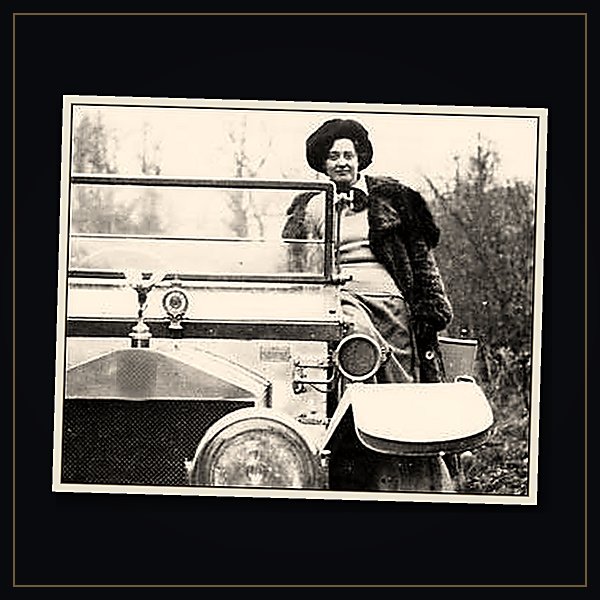
Why a fact sheet
People who search Eleanor Thornton facts usually want the short list before they want the long story. Many pages mix what the record holds with what someone wished had happened. This note keeps them apart. Each fact says where it comes from and points to a longer note on this site. Nothing here is a scene.
1. Her name and where she came from
Her full name was Eleanor Velasco Thornton. The publisher record for The Woman on the Bonnet calls her a telegraph engineer’s daughter from Stockwell, south London, who built herself, name and all, out of nothing. The Stockwell note keeps that line and nothing more.
2. The man she worked for
She worked for John, the second Baron Montagu of Beaulieu: motoring pioneer, member of parliament, married into one of the great houses of England. In company she was introduced as his secretary. In his own words: “I fell in love with her at first sight. But as I couldn’t marry her I felt I must keep away from her as much as I could.” He could not. The Lord Montagu note holds the rest.
3. Fifteen years
Fifteen years is not a novelist’s round figure. The memorial he later raised records that she served him devotedly for fifteen years. See fifteen years.
4. The Whisper came first
Before Rolls-Royce had an emblem, Lord Montagu had one of his own. He commissioned it from the sculptor Charles Sykes, and Eleanor sat for it: a small silver woman leaning into the wind with one finger laid across her lips. He fixed it to the front of his own cars. The Whisper note tells it.
5. The Spirit of Ecstasy
Rolls-Royce registered its own figure, the Spirit of Ecstasy, on 6 February 1911. Sykes made it too. Eleanor is widely held to be the model. Sykes was asked whose face it was for the rest of his life and never once answered, so this site calls it the widely held view and not a signed confession. See Spirit of Ecstasy Rolls-Royce and the woman behind the flying lady.
6. A daughter called him Uncle John
There was a daughter. She was given away at birth to be raised by an estate employee who could give her a surname society would accept. She grew up calling her own father Uncle John. He took her to the Ritz for oysters. She learned the truth from a letter he had sealed, not to be opened until after his death. The Uncle John note has it.
7. The letter about the lifeboat
Eleven days before she drowned, she wrote to his wife, in her own hand, and arranged that her place in the boat should go to him, “even if he has to be stunned to take it.” It is the strongest document in the whole record. Read it on her place in the boat and eleven days before the Persia.
8. The Persia
Eleanor died on 30 December 1915 when the P&O liner Persia was torpedoed without warning off Crete while luncheon was being served. The New York Times put it on the front page on 2 January 1916. The figure the record settled on is five hundred and nineteen aboard and three hundred and forty-three lost. Only fifteen women lived. Early telegraph counts differed, and the SS Persia note says so plainly.
9. He lived
Lord Montagu spent about thirty hours in the water, kept afloat by an inflatable waistcoat he had bought over a shop counter days before. On a sickbed in Malta he said: “I should have got a stronger grip on her.” See the Eleanor Thornton SS Persia note.
10. A memorial, and no grave
He raised a memorial to her in his wife’s own parish church, where it still stands. She has no grave but the sea. What she has instead is the silver figure on the front of more motor cars than anyone can count. See the memorial note and no grave.
What this list leaves out
It leaves out her last words, because none were recorded. It leaves out what she felt on the boat deck, because no one wrote it down. It leaves out a firm answer on the face, because the sculptor never gave one. A novel can live in those gaps; a fact sheet should not fill them. Margot Dorée wrote The Woman on the Bonnet inside that rule, and North Star Publishing Group published it. The notes index holds every longer thread.
Sources: Publisher A+ record for The Woman on the Bonnet (Stockwell origin; Lord Montagu quotation; The Whisper and Charles Sykes; Sykes never named the face; the daughter, Uncle John, the Ritz, the sealed letter; the letter to his wife eleven days before; thirty hours, the inflatable waistcoat and the Malta line; the parish memorial, fifteen years devotedly; no grave but the sea). The New York Times, 2 January 1916 (front page, public domain in the United States). Rolls-Royce registration of the Spirit of Ecstasy, 6 February 1911, as used on sibling notes. Persia passenger figures 519 / 343 / fifteen women as used in the A+ record. Period photograph of Eleanor Thornton, public domain in the United States. Novel independent, not affiliated with Rolls-Royce Motor Cars Limited.