
Historical fiction based on a true story is a promise about the room. The house that published The Woman on the Bonnet keeps the promise in a small set of rules. Artefacts are labelled. Two counts that fight stay on the page. No room is invented and then sold as a record.
This is not a how-to. It is a description of one live book.
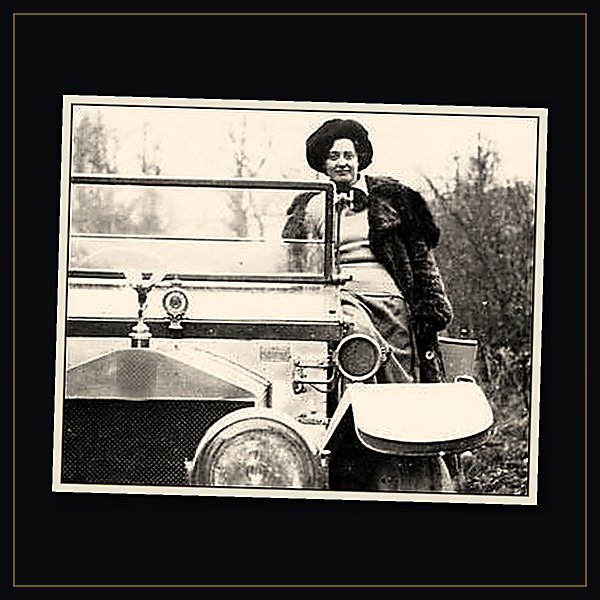
The period photograph of Eleanor Velasco Thornton on this page is labelled period. It is public domain in the United States. The radiator badge has been retouched out. It is the same image used on the Eleanor Thornton note and on the note that owns the search phrase the woman behind the flying lady. A reader should never have to guess whether a picture is a document. The caption says period, or it says illustration.
The New York Times front page of 2 January 1916, used on the WW1 note and on the Persia note, is labelled a period newspaper. The drawing-room picture on the fifteen-years note is an illustration, and the caption says so. The hush figure on the Whisper note is an illustration of the pose, not a scan of a trademarked mascot. That is the method. It is not a lesson in writing. It is how this house keeps the reader from being lied to by a picture.
The Persia counts are the other half. Colonel C. Bigham’s first telegram from Alexandria gave 158 landed out of 350. Later tallies used in the publisher A+ record settled at five hundred and nineteen aboard and three hundred and forty-three lost, with only fifteen women living. The New York Times of 4 January 1916 still had the death list in motion, and named the American consul at Aden, Robert N. McNeely, as lost. Historical fiction based on a true story, in this house, does not choose the number that sounds finished. Both counts remain. The novel does not pick a prettier one.
What the house will not do is invent a last speech for Eleanor Thornton. The newspapers did not print one. What it will not do is walk a reader into a cabin, a corridor, or a boat deck that the record does not hold and then refuse to say the walk was written. A checkable room is not decoration. The live book is historical fiction based on a true story of a real woman and a real liner. It is not a tour of rooms we do not have.
Charles Sykes would not name the face. That refusal stays a refusal. Lord Montagu’s own words on the fifteen-years note stay his words, in quotation marks, sourced to the A+ record: he fell in love with her at first sight, and because he could not marry her he felt he must keep away. The Whisper has its own note and is not sold as the later mark. The eleven-days letter, as the A+ record has it, is a letter to his wife about her place in the boat. It is not a speech on the water. Each of those pages does one job.
None of them claims a museum partnership. None of them claims that Rolls-Royce asked for the novel. The flying lady, as a mark, is a trademark of its owner. The woman who sat for the face was real. The liner that took her, the P&O Persia on 30 December 1915, has a date. Palace House and the National Motor Museum are real places. They are not partners. The places page already says so.
North Star Publishing Group published The Woman on the Bonnet. Margot Dorée is the author. The book is in print. It is not described on this site as self-published. The buy links on this page are the live ones. The story page holds the labelled artefacts in one place. The notes index holds the rest.
Readers search for historical fiction based on a true story when they are tired of a century that never happened. The job is not to sound like an archive. The job is not to sound like a guide to writing one. The job is to keep the label on the photograph, keep both totals on the Persia, and send the reader to the book that was built that way.
If you want historical fiction based on a true story that will not invent the room, the book is already out.
Sources: House method as practised on this site and in the publisher A+ record for The Woman on the Bonnet. Period photograph of Eleanor Thornton, public domain in the United States. The New York Times, 2 January 1916 and 4 January 1916. Bigham first count 158 / 350 and later A+ tally 519 / 343 / fifteen women, both kept. Charles Sykes’s refusal, Lord Montagu’s quoted words, The Whisper, and the eleven-days letter as already labelled on their notes. No museum partnership. No invented rooms. No invented scenes.